Are you thinking about improving a barn, arena, or turnout area in Loudoun County? It is easy to focus on the building or riding surface first, but on horse property, the land usually makes the biggest difference. If you plan your upgrade around drainage, soils, airflow, and daily traffic patterns, you can create a facility that works better now and holds its appeal over time. Let’s dive in.
Start With The Site
In Loudoun County, equestrian upgrades are shaped by the land as much as the structure. The county notes that highly erodible soils, steep slopes, mountainside areas, numerous waterways, and heavy thunderstorms can all increase erosion risk. That means a barn, arena, or turnout project should begin with the site itself, not just the wish list.
The county also treats land disturbance broadly. Clearing, grading, excavating, transporting, and fill can all count as land disturbance, which matters when you are planning where to place improvements and how much of the site you want to change.
Loudoun’s stormwater program is designed to reduce runoff impacts, control runoff peaks and volumes, treat post-construction runoff, and maintain vegetative or structural best management practices. Just as important, the county notes that soils can affect foundation stability and that local geology can create land-use challenges. In practical terms, your upgrade should be viewed as a full site system.
Check County Review Early
Before you finalize a concept, it makes sense to check the current county framework. Loudoun County’s current Zoning Ordinance was adopted on December 13, 2023, so barn and arena plans should be reviewed against the current rules at the start of the process.
The county identifies barns and run-in sheds as agricultural structures, and a Farm Building or Structure Application is required for agricultural structures regardless of size. If your property is inside an incorporated town, town approval may also be part of the review.
Project size matters too. Loudoun’s erosion guidance says land disturbance above 5,000 square feet generally triggers grading permit review, and lower thresholds may apply in steep-slope, mountainside, or limestone-sensitive areas. A design that limits disturbance in the right areas can make a meaningful difference.
Smaller Parcels Need Extra Attention
If your parcel is under 5 acres, certain uses such as animal husbandry may require a Conservation Farm Plan developed with the Loudoun Soil and Water Conservation District and Virginia Cooperative Extension. This process is intended to match the parcel’s carrying capacity and best management practices.
Even when it is not the first thing owners think about, that planning framework can be very helpful. It gives you a practical way to evaluate how much turnout, storage, and lane space the land can realistically support.
Put Layout Before Materials
Many owners want to jump straight to footing, fencing, or finishes. In most cases, the better sequence is to confirm drainage and soils constraints first, decide traffic patterns and building locations second, and choose footing and turnout materials last.
That order matters because high-use areas tend to create the biggest long-term headaches. If the barn, feeding area, gates, and access lanes are poorly placed, even expensive materials may not solve persistent mud, runoff, or maintenance issues.
Favor Higher Ground
A strong first principle is to place barns, feed storage, shelters, and other high-use areas on higher ground. University of Minnesota Extension recommends this approach for mud control and suggests an ideal slope of about four to six degrees for drainage.
For Loudoun County properties, this can be especially useful because stormwater, erosion risk, and soil conditions vary so much from site to site. Siting improvements well from the start can reduce wear on the facility and make daily chores simpler in wet weather.
Think In Daily Traffic Patterns
When planning an upgrade, think about how horses, equipment, and people move through the property every day. Gates, lanes, shelter entrances, feeding locations, and arena access points often become the most worn parts of the farm.
That is why layout should account for repeated hoof traffic and vehicle movement, not just the ideal placement on paper. A polished barn means less if the path to turnout stays muddy for much of the year.
Plan For Drainage Everywhere
Drainage should not be limited to the arena base or the barn site. It should connect the roof, turnout areas, lanes, and working surfaces into one coordinated plan.
UMN Extension recommends gutters on all buildings and drainage ditches or swales to route water away from worked surfaces and toward appropriate drainage areas. That recommendation fits well with Loudoun County’s broader stormwater priorities.
Protect High-Traffic Areas
For turnout and circulation areas, permanent high-traffic pads can make a major difference. UMN Extension recommends them at gates, lanes, shelters, and feeding spots, using layered stone and drainage details.
Fine-crushed gravel is recommended as a durable top layer, and crushed bluestone is also considered appropriate. By contrast, straw, hay, and wood chips tend to break down quickly, which can leave you back where you started.
Reduce Sand Ingestion Risk
Surface choices affect horse management too. UMN Extension notes that feeding horses on sand-based surfaces can create a sand-ingestion risk.
A simple design choice like elevated feeders can help reduce that risk. It is a good example of why equestrian planning works best when the land, the horses, and the daily routine are considered together.
Design Barns For Airflow
A beautiful barn that traps moisture is not a successful upgrade. Penn State notes that horse barns need air exchange to remove moisture and condensation, and that natural ventilation is driven by wind and thermal buoyancy through sidewall and ridge openings.
If you are insulating a barn, that does not remove the need for ventilation. The design still needs to preserve airflow rather than creating an airtight building.
Let Breezes Do The Work
Because wind is the dominant force in natural horse-barn ventilation, barn orientation should support prevailing breezes when possible. Open, unobstructed interior pathways also help fresh air reach stalls instead of leaving the aisle as the only well-ventilated area.
This is one of those details that affects comfort, upkeep, and the overall feel of the facility. Buyers who understand horses often notice right away when a barn feels dry, open, and easy to maintain.
Place Manure Areas Thoughtfully
Manure handling areas should also be part of the layout conversation. Penn State advises placing them downwind of the stable and residential areas when possible.
That decision can improve odor control and daily function without adding much cost. It is a small planning move that can have an outsized impact on how the property works.
Match Footing To Use
There is no single perfect arena footing for every Loudoun County property. Penn State notes that footing should be matched to the riding discipline, local material supply, transport cost, traction, dust control, and your ability to maintain it.
That is why the right question is not “What is the best footing?” but “What footing works best for the way you ride and maintain the property?” A practical answer usually leads to a better long-term result.
Know The Basic Arena Guidelines
Penn State identifies cleaned, screened, medium-to-coarse hard angular sand as a common baseline for riding surfaces. It also notes that topsoil is generally a poor footing choice because it compacts, becomes dusty when dry, and can become slippery when wet.
Very deep sand can also stress tendons. In other words, more footing is not always better.
Plan Maintenance From Day One
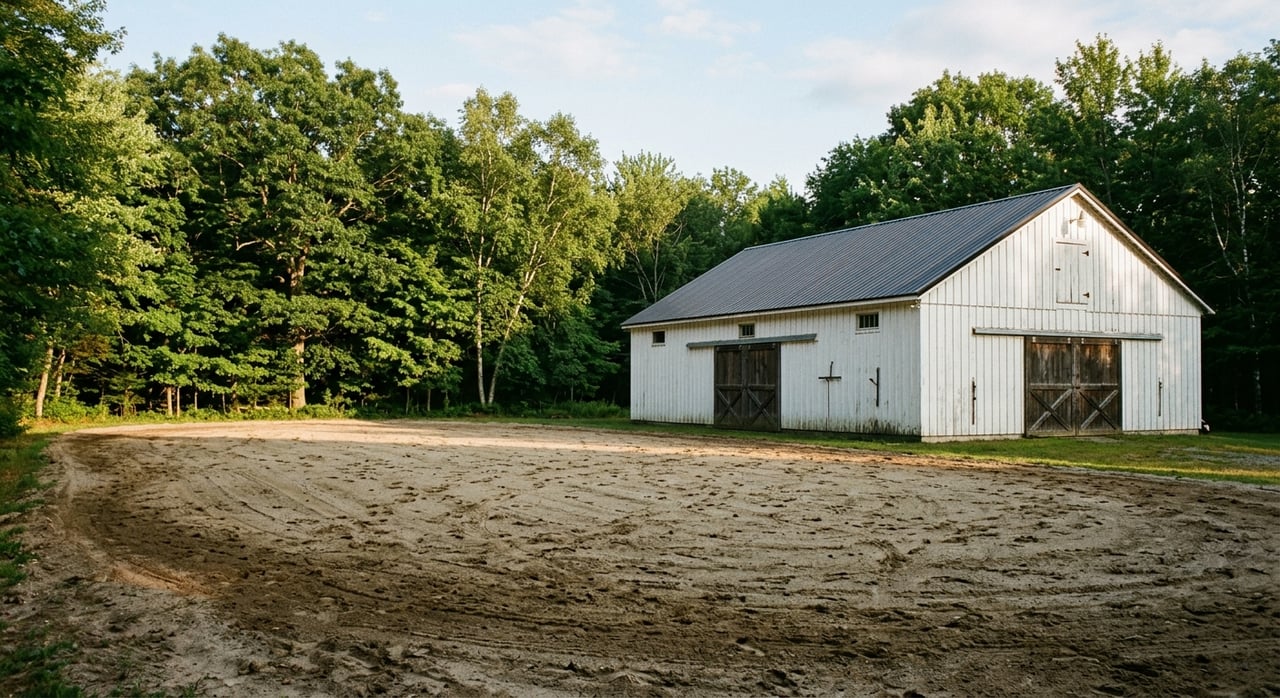
Arena maintenance should be designed into the project, not treated as an afterthought. Hoof traffic tends to concentrate at the rail, diagonals, jump lines, and instructor positions, so the surface needs to be one you can drag or harrow back into place.
Depending on the material, watering may also be part of the plan. If you do not want intensive maintenance, your material choices should reflect that from the beginning.
Choose Stall And Aisle Surfaces Carefully
Inside the barn, flooring should support drainage, daily cleaning, and safe footing. Penn State notes that sand drains well, and road-base style mixes may be built over a sand or small-gravel drainage layer.
Wood-based materials may feel softer, but they can become slick when wet and may be harder to disinfect. That tradeoff matters if you are trying to balance comfort, durability, and ease of upkeep.
Work With Equine-Experienced Pros
Not every contractor understands horse property. Penn State cautions that some quick-fix turnout assemblies using loose geotextile fabric can be damaged by hoof action, which is one reason to use an equine-experienced contractor rather than a generic site contractor.
That advice is especially relevant in Loudoun County, where site conditions, runoff concerns, and review thresholds can all affect the final result. An equestrian facility is not just another outbuilding project.
Focus On Upgrades That Last
From a resale perspective, the most transferable improvements are often the least flashy. Better grading, dependable drainage, dry turnout, safe airflow, and footing systems that stay functional after rain can improve daily use now and strengthen appeal later.
That matters in Loudoun County, where buyers of horse property often look closely at operational fit. A facility that handles weather well and supports a workable routine tends to stand out.
If you are prioritizing your investment, these are often the upgrades worth making first:
- Site grading that supports drainage
- Dry, durable high-traffic turnout areas
- Barn placement on stronger, higher ground where possible
- Ventilation that supports consistent air exchange
- Arena footing matched to discipline and maintenance capacity
- Roof-water management with gutters and directed drainage
A thoughtful facility upgrade is about stewardship as much as convenience. When your plan respects the land, supports the horses, and fits the parcel, you are far more likely to end up with an improvement that performs well and adds lasting value.
If you are weighing improvements before a sale, evaluating a purchase with upgrade potential, or looking for a horse property with the right operational foundation in Loudoun County, Horse Farms & Country Homes can help you assess what matters most.
FAQs
What should you evaluate first for an equestrian facility upgrade in Loudoun County?
- Start with the site conditions, including soils, slopes, waterways, drainage patterns, and the amount of land disturbance your plan may require.
Do barns need county review in Loudoun County?
- Loudoun County treats barns and run-in sheds as agricultural structures, and a Farm Building or Structure Application is required for agricultural structures regardless of size.
When can grading review affect a horse property project in Loudoun County?
- County guidance says land disturbance above 5,000 square feet generally triggers grading permit review, with lower thresholds possible in steep-slope, mountainside, or limestone-sensitive areas.
How should you place a barn on a Loudoun County horse property?
- A sound approach is to place barns and other high-use areas on higher ground when possible so drainage works better and mud problems are easier to control.
What footing works best for a riding arena in Loudoun County?
- There is no one-size-fits-all answer. Arena footing should match your riding discipline, local material options, budget, dust control needs, and maintenance capacity.
What turnout upgrades help reduce mud on horse property?
- Permanent high-traffic pads at gates, lanes, shelters, and feeding areas, built with layered stone and drainage details, are among the most practical mud-control improvements.
Why does barn ventilation matter in an equestrian facility upgrade?
- Horse barns need steady air exchange to remove moisture and condensation, so ventilation should be preserved even in insulated barn designs.
What upgrades tend to support resale on a Loudoun County horse property?
- Improvements that reduce mud, improve airflow, manage runoff, and keep arenas and turnout usable after rain are often the most broadly appealing.